
Artificial Grass Installation Quotes: Why Prices Vary
You've measured the yard, picked out a few grass samples, and had three contractors come out. Then the estimates arrive, and one is thousands of dollars higher than another for the same square footage.
We get asked about this every week. Usually the difference comes down to work the homeowner will never see once the turf is down. Here's what we'd look for if we were comparing quotes on our own yard.
You've measured the yard, picked out a few grass samples, and had three contractors come out. Then the estimates arrive, and one is thousands of dollars higher than another for the same square footage.
We get asked about this every week. Usually the difference comes down to work the homeowner will never see once the turf is down. Here's what we'd look for if we were comparing quotes on our own yard.
Most of the price gap is underneath the grass
Everybody wants to talk about the turf. We'd rather talk about the dirt.
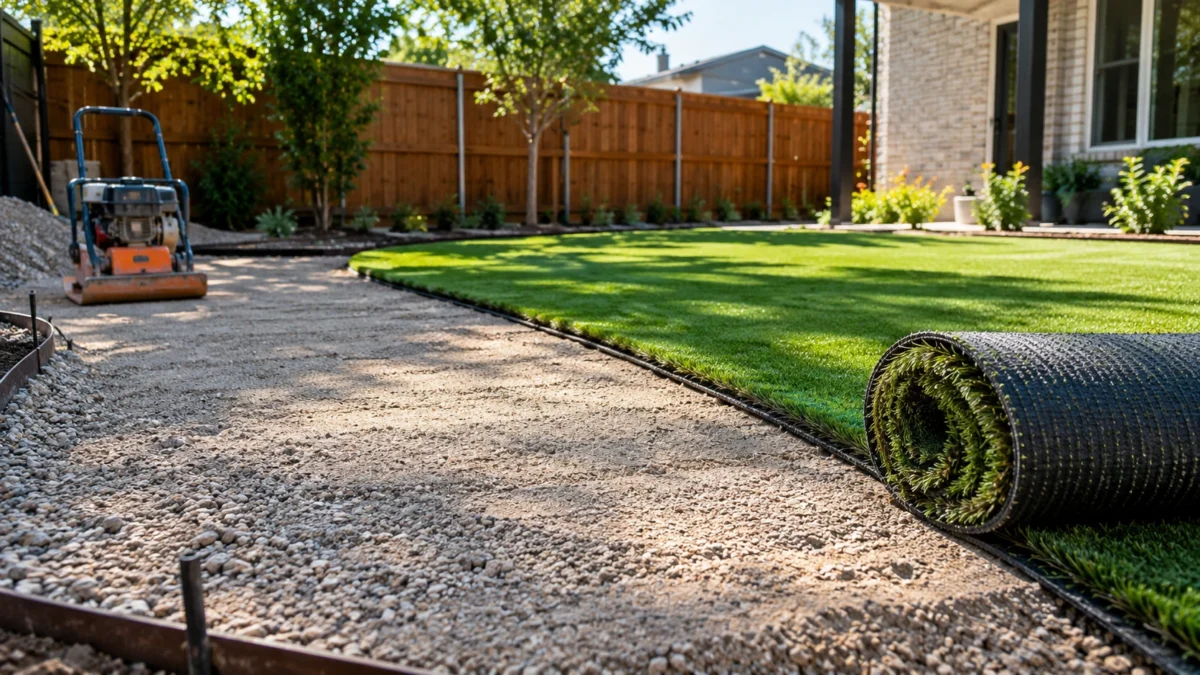
Our standard install removes the existing grass and roughly 3 to 5 inches of soil. We then build a base of 3 to 5 inches of crushed limestone, compact it in layers with a plate compactor, and top it with a thin layer of decomposed granite before the turf goes down. That base is the foundation of the whole lawn, and on most jobs it accounts for about a third of the labor. It's back breaking work!
It matters more in Dallas than in a lot of places. Our clay soil swells when it gets wet and shrinks as it dries. If turf sits on a thin or poorly compacted base, the soil moves and shows up within a year or two as dips, ripples, and spots where water sits and collects.
Last spring we were called to a backyard in Frisco where turf had been installed about three years earlier. When we pulled it back, the "base" was an inch and a half of sand laid straight over clay. The homeowner had paid less upfront, but fixing it meant tearing out the lawn and starting over, so they ended up paying twice. We spend a surprising amount of time fixing installations that other companies got wrong.
When you're comparing quotes for artificial grass installation, look for:
- How deep they're excavating
- What base material they're using, and how much
- How it will be compacted
- Whether grading is included
"Ground prep included" doesn't tell you any of that.
The turf samples don't tell the whole story
Two samples can look and feel almost identical and still perform very differently. Face weight, meaning the weight of the fibers per square yard, is a useful number, but heavier isn't automatically better. Blade shape, backing, drainage rate, and UV protection all matter, especially in a yard with three dogs or one that bakes in afternoon sun.
Heat is a real issue here. In July, turf in full sun can get noticeably hotter than natural grass. If your backyard faces west and the kids play out there after school, we'll talk with you about product choices and options like cooling infill.
Ask every contractor for the manufacturer and exact product name, not just "premium synthetic turf." You can look up the specs and warranty yourself and compare them side by side. For our options, see our residential landscape turf page.
Drainage problems don't go away under turf
Most turf lets water drain straight through, but the water still has to go somewhere once it hits the ground. If your yard already holds water along the fence or slopes toward the house, putting turf over it won't fix that.
Depending on the yard, the fix might be regrading, adding a French drain, or redirecting a downspout. On a typical backyard, drainage work can easily add $800 to $2,500, and it's one of the most common reasons two quotes don't match. One contractor includes it and the other doesn't mention it.
The next time it rains hard, take a few photos of where the water collects and show them to whoever comes out to quote. Then check that the estimate says whether drainage work is included.
Access affects the price too
A wide side gate and a flat, rectangular yard make an install quicker. A 36-inch gap between houses, a pool surrounded by curved beds, or a backyard a few steps up from the driveway make it slower.
On a standard 1,000 sq ft backyard, we haul out around 10 to 12 cubic yards of soil and bring in roughly the same amount of base. If a skid steer can't fit through the side yard, all of that goes by wheelbarrow. That can add a day or more of labor without adding any square footage to the lawn.
Layout matters as well. Artificial grass typically comes in rolls 15 feet wide. Every curve, tree, and odd corner means more cuts, more seams, and more waste. Seams also have to be laid with the grain running the same way. If they aren't, the sections look like slightly different colors.
That's why price per square foot only tells you part of the story. It tells you how much lawn you're buying, not how hard it is to build.
Check what's left out of the estimate
Before you compare totals, compare what each estimate actually covers:
- Removal of the existing lawn and haul-off
- Grading and base material (type and depth)
- Drainage work, if needed
- Turf manufacturer, product name, and infill
- Edging and border treatment
- Cleanup and repair of anything disturbed during the install
- Product warranty and workmanship warranty
Pay close attention to exclusions. It's fine for a contractor to leave something out, as long as you know before you sign. Problems start when one quote includes base work and drainage, another doesn't, and the homeowner only compares the numbers at the bottom.
Also ask what happens if the crew runs into something unexpected once they start digging, like buried concrete, roots, or a broken sprinkler line. Find out how extra work gets approved and priced, and get that in writing.
A good question to ask whoever's quoting your yard
"What about my yard concerns you?"
Every contractor will tell you they do quality work. This question shows whether they actually looked. A good answer might be the slope by the patio, getting equipment through the side gate, or the corner where your dogs run. If they say nothing worries them, that's fine too, as long as they walked the whole yard before saying it.
So which quote is right?
A higher quote doesn't guarantee better work, and a lower one doesn't always mean shortcuts. When the gap is several thousand dollars, though, ask each contractor to walk you through it. Usually it comes down to base prep, the turf product, drainage, or access.
For reference, most of our backyard installs in the Dallas area land between $8.5 and $15 per square foot depending on how much prep, drainage, type of grass, type of infill and access work the yard needs. Some have been higher, some lower, but this is why we do everything custom.
Already have a quote?
Bring it when you talk to us. We'll come look at your yard, ask how you plan to use it, and give you a written estimate that spells out every line item. If you're comparing proposals, we're happy to go through them with you, even if you don't end up choosing us.
Get a Free Estimate for Your Project
Tell us a few details and our team will provide a fast, no-obligation quote tailored to your space.
✓ Professional grade turf and installation
✓ Local expertise, fast scheduling
✓ Transparent pricing — no surprises
Premium artificial turf installations from a local company you can trust for durability, performance, and long term value.
Services
Address
12080 Forestgate Drive
Dallas, TX 75243
Service Area Map
Hours of Operation
Monday - Friday 9am - 7pm
Saturday 9am - 4pm
Download
Homeowner's
Turf Guide

Premium artificial turf installations from a local company you can trust for durability, performance, and long term value.
Address
12080 Forestgate Drive
Dallas, TX 75243
Service Area Map
Hours of Operation
Monday - Friday 9am - 7pm
Saturday 9am - 4pm
Download Homeowner's
Turf Guide

Company
972-640-7101