
Let's talk about something nobody wants to discover after spending good money on a beautiful new backyard.
Dog pee
More specifically, the smell of dog pee baking in the Texas sun.
It's one of the most common concerns homeowners have when considering artificial grass for dogs, and understandably so. You want a backyard that looks great, stays green, and doesn't turn into a muddy mess every time it rains. But if the tradeoff is a yard that smells like a dog kennel by the middle of July, what's the point?
So, does artificial grass smell when dogs pee on it?
It certainly can. But it doesn't have to.
And understanding the difference before you install pet turf can save you a considerable amount of frustration down the road.
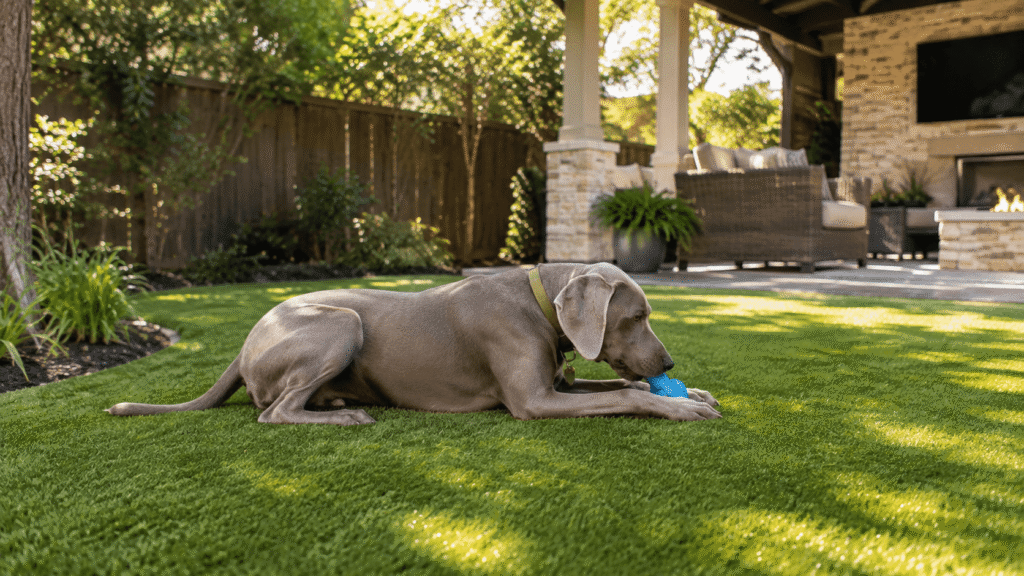
First, What Actually Happens When Your Dog Pees on Artificial Grass?
With natural grass, urine soaks into the soil. Some of it gets absorbed, some drains away, and some can damage the grass, leaving behind those familiar yellow and brown patches.
Artificial grass works differently.
The synthetic fibers themselves generally don't absorb much liquid. Instead, urine passes between the blades and through the turf's backing into the materials underneath.
At least, that's what it's supposed to do.
If everything is installed correctly, liquids have a way to drain through the system. If they're not, urine can collect in the backing, infill, or underlying base. Over time, that residue can produce some pretty unpleasant odors.
And here's the part that catches homeowners off guard: you can't necessarily tell how well a pet turf system will drain just by looking at the finished lawn.
Two backyards can look almost identical on installation day. Six months later, one still looks and smells great, while the other has become a problem.
Much of that difference comes down to what's happening underneath the grass.
Dallas Summers Have a Way of Exposing Problems
Let's be realistic about where we live.
Dallas summers are brutal. When it's 100 degrees outside, your patio furniture is hot, your driveway is hot, and your artificial grass can get pretty hot, too.
Now imagine urine residue sitting in that environment day after day.
Heat can make existing odors much more noticeable, particularly when the same areas are being used repeatedly.
That's why a pet turf installation that seems perfectly fine during a pleasant spring afternoon might tell a different story in August.
It doesn't mean artificial grass is a bad choice for dogs. It means the installation needs to account for the environment it's going into.
We've written more about how artificial grass performs during the Texas summer, because heat is something every Dallas homeowner should understand before making the switch.
Not All Artificial Grass Is Made for Dogs
Here's something worth knowing before you start comparing turf samples.
The artificial grass that looks beautiful around a swimming pool isn't necessarily the same product we'd recommend for a backyard with three Labrador retrievers.
Different yards have different demands.
Think about how your dogs actually use the space. Do they spend most of their time lounging in the shade? Are they constantly running the same path along the fence? Do they have one favorite bathroom spot, or is the entire backyard fair game?
Those details matter.
When we're evaluating pet turf installation for a Dallas backyard, we're looking beyond the color and softness of the grass.
We're considering how well it drains, how durable the fibers are, what type of backing and infill make sense, and how easily the homeowner will be able to keep everything clean.
And yes, we want it to look great. Nobody wants a backyard that resembles the outdoor area of a veterinary clinic.
But appearance is only part of the equation.
The best artificial grass for dogs is the grass that fits the dogs, the property, and the way the family actually lives.
So Why Do Some Artificial Grass Yards Smell Terrible?
Usually, there's a reason. Sometimes several.
And while it's tempting to blame the turf itself, the problem often goes deeper.
The Urine Has Nowhere to Go
Imagine pouring a glass of water onto a sponge sitting inside a shallow bowl.
The water goes through the sponge, but it doesn't really go anywhere. Eventually, the bowl fills up.
A poorly draining turf installation can create a similar problem.
Urine passes through the grass but gets trapped in the materials below, where residue can accumulate.
This is particularly important in North Texas because our clay-heavy soils don't always make drainage easy.
A properly designed installation needs to consider the existing soil, grading, base materials, and where water will ultimately go.
Simply putting artificial grass over the ground and hoping for the best isn't much of a strategy.
The Wrong Materials Were Used
Not every turf backing or infill material is appropriate for a yard that doubles as a dog bathroom.
Some materials can retain moisture or make urine residue more difficult to remove.
There are infill products specifically marketed for pet applications, including options designed to help manage odors. They can be useful, but they're not magic.
If the drainage underneath is poor, an expensive infill isn't going to solve the underlying problem.
We'd rather get the fundamentals right first.
Nobody Is Cleaning It
This one deserves a little common sense.
Artificial grass is low maintenance. It isn't no maintenance.
If your dog uses the same corner of the yard as a bathroom three times a day, every day, that area is going to need attention.
You'll still need to pick up solid waste, rinse heavily used areas, and occasionally use an appropriate pet turf cleaner.
How often depends on your dogs, how much space they have, and how they use it.
For a homeowner with one small dog and a large backyard, maintenance may be fairly simple. Three large dogs sharing a narrow side yard? That's a different situation entirely.
There's no reason to pretend otherwise.
How Do You Get Dog Urine Smell Out of Artificial Grass?
Let's say you already have artificial grass and you've started noticing an unpleasant smell.
Before assuming the entire installation is bad, start with a few simple things.
First, make sure solid waste is being removed regularly. Then give the areas your dogs use most frequently a thorough rinse.
If the smell persists, try an enzyme-based cleaner specifically formulated for pet urine and approved for use on artificial grass. These products are designed to help break down the organic residue responsible for many pet odors.
Follow the manufacturer's directions, and avoid experimenting with harsh household chemicals that could damage the turf or surrounding landscaping.
For many homeowners, a sensible cleaning routine makes a noticeable difference.
But what if you clean the turf and the smell keeps coming back?
That's when we'd start asking more questions.
Is water draining properly? Is there a particular area that stays damp? Was the turf originally installed for pets? What kind of infill was used?
Sometimes the problem is accumulated residue near the surface. Other times, the materials underneath may need attention.
If the source of the odor is beneath the turf, spraying more cleaner on top may only provide temporary relief.
Is Artificial Grass Actually Better Than Natural Grass for Dogs?
For plenty of Dallas homeowners, absolutely. But it depends on what you're trying to accomplish.
Let's start with the obvious advantages.
No more muddy paw prints across the kitchen floor after a rainstorm. No more yellow patches where the dog insists on using the same spot. No more bare dirt along the fence where your German Shepherd has decided to patrol the perimeter every afternoon.
And you can stop trying to grow grass in that shady corner of the yard where nothing seems to survive.
Those are real benefits.
But there are considerations, too.
Artificial grass can get hotter than natural grass in direct sunlight. Dogs still need access to shade and a comfortable place to rest during hot weather.
You'll also need to rinse and clean areas where they regularly relieve themselves.
And if your dogs love digging, you'll want to discuss that before installation so the turf and edges can be designed with their behavior in mind.
For some families, artificial grass throughout the entire backyard makes sense.
For others, a combination of pet-friendly artificial turf, natural landscaping, and shaded areas works better.
There's no rule saying every square foot has to be artificial grass.
If you're still weighing the options, take a look at our comparison of artificial grass versus natural grass.
What About Homes With Two, Three, or Four Dogs?
This is where planning becomes particularly important.
One dog using a large backyard puts very different demands on a lawn than four dogs sharing a relatively small space.
More dogs generally mean more concentrated bathroom activity, more traffic, and more cleaning.
That doesn't mean artificial grass is off the table. In fact, households with multiple dogs can be some of the best candidates for pet turf, especially when natural grass has already been worn down to dirt.
But we need to design for reality.
Sometimes that means choosing a more durable turf product. Sometimes it means paying extra attention to drainage in certain areas.
And sometimes it makes sense to create a dedicated pet relief area instead of having the dogs use the entire backyard.
Think about it. If you enjoy having friends over for dinner, wouldn't it be nice to have a separate area for the dogs rather than wondering where everyone should put their lawn chairs?
A little planning can make the space more enjoyable for the whole family. And as your dogs get older, their needs will change. We've covered some of those considerations in our article on how pet turf benefits dogs from puppies through their senior years.
Why Professional Pet Turf Installation Matters in Dallas
There's a lot more to installing artificial grass than rolling out a green carpet.
And unfortunately, some of the most important work is the part homeowners never see once the project is finished.
We're talking about excavation, grading, base preparation, compaction, drainage, and selecting the right materials for the application.
Those details become especially important when the finished lawn will be used by dogs every day.
At Synthetic GreenScapes, we start by understanding the property and how the homeowner intends to use it.
How many dogs do you have? Where do they usually go to the bathroom? Does the yard have existing drainage problems? Are there shaded areas? Is the space primarily for the dogs, or does it need to work for entertaining and family activities, too?
These aren't complicated questions, but the answers help determine what kind of installation makes sense.
With more than 60 years of combined industry experience and thousands of installations throughout the Dallas area, our team has learned that the details you don't see are often the ones that matter most.
That's true whether we're installing a complete residential lawn, a dedicated dog run, or a small pet-friendly section of an existing backyard.
You can learn more about our broader artificial grass installation services in Dallas and how we approach residential projects.
One Last Thing: Be Careful With the Word "Odor-Free"
You'll see plenty of artificial grass products advertised as odor-free, antimicrobial, or specifically engineered for pets.
Some have useful features. Others rely heavily on marketing language.
But here's the reality: if dogs are regularly urinating on a surface, that surface needs to be able to drain and it needs to be cleaned.
No turf product can reasonably guarantee that you'll never experience an odor, regardless of how it's installed or maintained.
What you should expect is a system designed to manage pet waste effectively and make routine cleaning straightforward.
That's a much more useful promise.
Ready for a Backyard That Works for You and Your Dogs?
If you're tired of muddy paws, patchy grass, or constantly trying to repair the same worn-out sections of your lawn, artificial grass may be worth a serious look.
And if you're worried about dog urine odors, that's exactly the kind of conversation we'd rather have before installation.
At Synthetic GreenScapes, we design and install residential pet turf throughout Dallas, Plano, Frisco, Allen, McKinney, and surrounding North Texas communities.
We'll take a look at your yard, talk about your dogs, and help you understand what kind of turf system makes sense for your home.
No two yards are exactly alike, and we don't believe they should all be treated the same way.
Explore Our Pet Turf Installation Services
Or contact Synthetic GreenScapes to schedule a free, no-obligation estimate.

Get a Free Estimate for Your Project
Tell us a few details and our team will provide a fast, no-obligation quote tailored to your space.
✓ Professional grade turf and installation
✓ Local expertise, fast scheduling
✓ Transparent pricing — no surprises
Premium artificial turf installations from a local company you can trust for durability, performance, and long term value.
Services
Address
12080 Forestgate Drive
Dallas, TX 75243
Service Area Map
Hours of Operation
Monday - Friday 9am - 7pm
Saturday 9am - 4pm
Download
Homeowner's
Turf Guide

Premium artificial turf installations from a local company you can trust for durability, performance, and long term value.
Address
12080 Forestgate Drive
Dallas, TX 75243
Service Area Map
Hours of Operation
Monday - Friday 9am - 7pm
Saturday 9am - 4pm
Download Homeowner's
Turf Guide

Company
972-640-7101